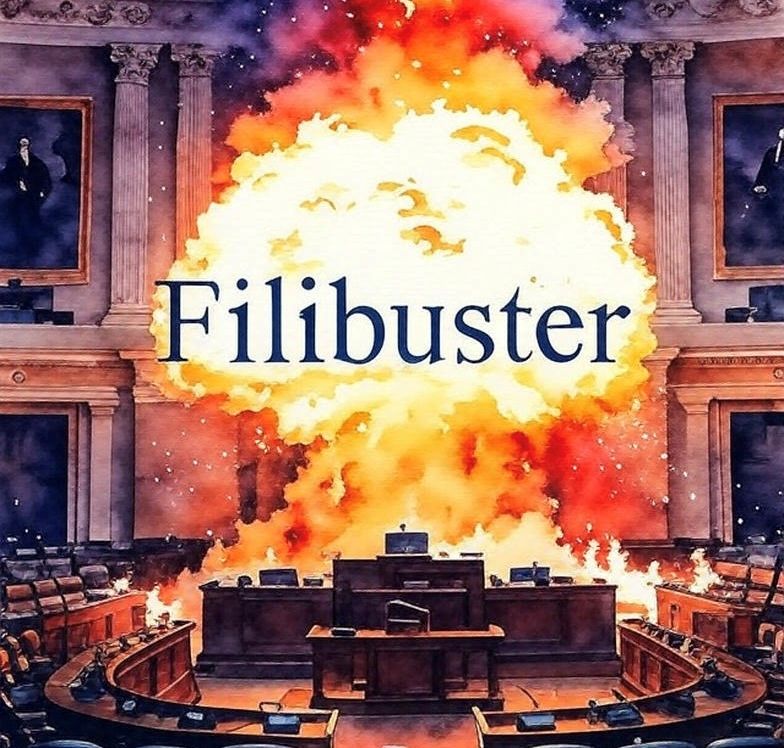
The Newscasters’ Insights
The Filibuster Under Fire
Murray Edwards
The filibuster is a procedural tactic in the United States Senate that allows a minority of senators to prolong debate on a bill, effectively blocking its passage unless 60 votes can be mustered to invoke cloture and end the discussion. Originating from the Senate’s tradition of unrestricted debate, this procedure is recognized as one of the most contentious features in the landscape of American legislative politics.
Historical Origins
The term “filibuster” derives from the Dutch word for “freebooter” or pirate, reflecting its disruptive nature. It came to light in the early 19th century when the Senate eliminated a rule allowing a simple majority to end debate. The first notable filibuster occurred in 1837 over banking issues. Over time, it gained infamy during the civil rights era, when Southern senators used marathon speeches—sometimes lasting over 24 hours, as in Strom Thurmond’s 1957 record of 24 hours and 18 minutes—to obstruct anti-lynching and desegregation bills.
How It Works Today

Unlike the dramatic, talk-until-you-drop filibusters of old Hollywood films, modern filibusters are often “silent.” A senator simply signals intent to filibuster, and the bill is set aside unless supporters secure 60 votes for closure. This supermajority requirement applies to most legislation but not to budget reconciliation bills, judicial nominations (since 2013 for lower courts and 2017 for Supreme Court), or certain executive appointments.
Arguments For and Against
Proponents view the filibuster as a safeguard for minority rights in a chamber designed to temper majority rule. The filibuster was intended to encourage bipartisanship, force compromise and prevent hasty legislation on divided issues.
Critics argue it paralyzes Congress, enabling gridlock in an era of deep polarization. With partisan divides widening, the 60-vote threshold has led to legislative inaction on priorities like voting rights, climate change, and infrastructure. Democrats eliminated it for nominations under majority control, prompting accusations of hypocrisy when Republicans later blocked their agenda.
Recent Debates and Potential Reform
In recent years, calls to abolish or reform the filibuster have intensified. During the Biden administration, progressive Democrats pushed for its elimination to pass voting reforms and debt ceiling hikes, but moderates like Joe Manchin and Kyrsten Sinema resisted. The 2022 midterms and ongoing Senate battles over issues like abortion rights have kept the debate alive. Proposals include lowering the cloture threshold to 55 votes or requiring “talking filibusters” to make obstruction more visible and politically costly.
The filibuster embodies the Senate’s deliberative ideal but has increasingly highlighted its dysfunction. Whether it survives intact will shape American governance for decades, balancing protection of the minority against the will of the majority.