
The Newscasters’ Insights
Murray Edwards
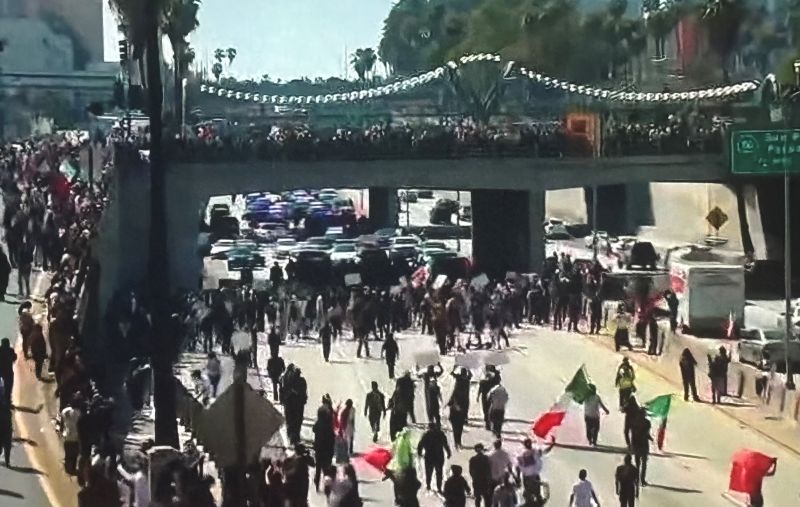
Progressive groups from across the country have locked arms to protest practically everything the Trump administration puts forward. From being against the deportations of illegal immigrants to banning men from participating in women sports, and nearly everything else in between, these groups will protest.
However, in the wake of Donald Trump’s elections in 2016 and 2024, two progressive grassroots organizations, Indivisible and 50501, have emerged as the major players to rally communities, resist right-wing policies, and advocate for their version of democratic values. While both groups share a commitment to countering “authoritarianism” and promoting inclusive democracy, they differ in their origins, strategies, and scope.
Indivisible: Their Blueprint for Local Resistance
Indivisible was established in late 2016, following the election of Donald Trump as the 45th President of the United States. The movement was founded by former congressional staff members Leah Greenberg and Ezra Levin, originating with the publication of the Indivisible Guide. This document, initially shared as a Google Doc, outlined strategies for grassroots resistance against the Trump administration’s agenda. Inspired by the localized activism of the Tea Party, the guide offered practical advice for citizens on influencing their elected officials through town halls, phone calls, and community organizing. By February 2017, shortly after President Trump’s inauguration, over 3,800 local Indivisible groups had formed across all 50 states. To facilitate coordinated campaigns, the organization was formalized as a 501(c)(4) nonprofit known as the Indivisible Project.
Indivisible’s mission is to “defeat the rightwing takeover of American government and win an inclusive democracy and bold progressive policies.” The organization emphasizes collective constituent power, encouraging local groups to build community, advocate for progressive values, and hold elected officials accountable. Its “inside/outside” strategy combines direct advocacy within systems of power with external pressure through protests and public campaigns. Indivisible also operates a “virtuous cycle” of advocacy and electoral work, pushing policy wins in non-election years and mobilizing voters during elections.
Indivisible groups engage in a range of actions, from organizing protests to attending town halls and supporting progressive candidates. During Trump’s first term, Indivisible played a significant role in opposing efforts to repeal the Affordable Care Act, with some analysts crediting the movement for the failure of the American Health Care Act in 2017. In 2025, following Trump’s second inauguration, Indivisible continued its activism, with chapters like the Mad River Valley group protesting JD Vance’s Vermont visit and others picketing Tesla dealerships to oppose Elon Musk’s influence. The organization also supports local groups with training, fundraising tools (via ActBlue), and media outreach, helping them generate earned media to amplify their impact.
The Indivisible Project has raised significant funds, with over $7.6 million from Open Society Foundations (SOROS) since 2017 and nearly $6 million in small donations by October 2017. In the 2024 election cycle, it reported $2.5 million in contributions and $177,473 in outside spending. With thousands of local groups and over a million members, Indivisible has built a robust network, though some analyses suggest not all registered groups remain active.
50501: A Rapid Response to Trump’s Second Term
The 50501 movement, named for its goal of “50 protests, 50 states, one day,” emerged in early 2025 as a grassroots response to Trump’s second presidency. Initiated by a Reddit post by user Evolved_Fungi in late January 2025, the movement quickly gained traction on social media with hashtags like “#50501” and “#buildtheresistance.” Unlike Indivisible’s structured origins, 50501 began as a decentralized, volunteer-led effort, later partnering with groups like Political Revolution, a Sanders-aligned organization.
50501’s core purpose is to unite Americans in opposition to Trump’s policies and perceived authoritarianism, with a particular focus on rejecting initiatives like Project 2025 and executive overreach. The movement emphasizes community-building and collective action, aiming to demonstrate widespread resistance through nationwide protests. While less ideologically rigid than Indivisible, 50501 aligns with progressive goals, advocating for democracy and against billionaire influence, notably targeting Elon Musk’s role in the Trump administration.
Key Activities
50501 with assistance from Indivisible have organized a series of high-profile protests in 2025, including:
February 5, 2025: The first nationwide protest, with 67 demonstrations across 40 states, reportedly drawing 72,000 participants.
February 17, 2025: “No Kings on Presidents Day” protests, coinciding with Presidents’ Day.
April 5, 2025: The “Hands Off” protests, among the largest anti-Trump demonstrations, with millions participating nationwide.
June 14, 2025: “No Kings” protests, held the U.S. Army’s 250th anniversary, avoiding Washington, D.C.
Upcoming – July 4th While most Americans will be celebrating the 249th anniversary of the United States, yet another batch of “No Kings” protests will be occurring across the country.
The movement also collaborated with the Women’s March for an April 19 “Day of Action” and supported May Day protests. Local groups, like Sandpoint 50501 in Idaho, have rallied against fascism and oligarchy, often in partnership with Indivisible chapters.
50501 operates as a loosely organized network, relying on grassroots enthusiasm rather than a centralized structure. This informality allows rapid mobilization but has drawn criticism for lacking long-term strategy or professional coordination. Posts on X have called 50501 “feckless” and criticized its protests as “government-approved” or lacking meaningful analysis. The movement’s partnership with established groups like Indivisible has helped provide resources, such as the “Musk or Us” Congressional Recess Toolkit, but its decentralized nature can lead to inconsistent messaging.
Indivisible and 50501 often work together, particularly at the local level. For example, in Sandpoint, Idaho, the local Indivisible and 50501 groups share a website and coordinate events like the June 14 “No Kings” rally. Indivisible has endorsed 50501’s protests, mentioning them in emails and toolkits, which has helped amplify the newer movement’s reach. Both groups share a commitment to resisting Trump’s agenda and defending democracy, but Indivisible’s established infrastructure and broader policy focus complement 50501’s protest-driven, rapid-response approach.
Both organizations are under scrutiny. Indivisible has been criticized for its connections to donors aligned with the Democratic Party, with some social media posts labeling it a “Democratic front.” Its reliance on funding from entities such as Open Society Foundations has raised questions about its independence, although Indivisible asserts that it maintains autonomy. Conversely, 50501’s protests have been described as “astroturf” by critics, including conservative commentator Benny Johnson, who has accused demonstrators of inciting violence. Supporters, however, contend that both groups “embody” genuine grassroots enthusiasm, with 50501’s spontaneity and Indivisible’s structure representing diverse methods of activism.
Indivisible and 50501 have played pivotal roles in shaping progressive resistance to the policies of President Trump. Indivisible’s consistent advocacy has had an impact on legislation and elections, while 50501’s protests have mobilized large groups, highlighting issues such as executive overreach and the influence of billionaires. As Trump’s second term progresses, both organizations are expected to continue evolving, intensifying their collaboration to counter perceived right-wing policies and strengthen democratic institutions.
What are their ultimate objectives?
Simple, to spread fear and uncertainly on current policies and to persuade as many people as possible that conservative values are not in the best interests of the country.